
Empower your agents to operate any software system.
Caylex makes AI agents fluent at working across industry-specific software systems.

Caylex Platform
Connect, orchestrate, and govern every system your agents touch:
Connect
Ingest any API, web app, or database
Ingest API specs, docs, or browser interactions to create an MCP — unlock the long tail of industry-specific tooling for your agent.
Curate the right toolset for your workflows
Collaborate with the MCP Designer Agent to select and design tools based on your personalized use cases.
Validate that your toolset actually works
Simulations map dependencies across endpoints to ensure every tool has the inputs it needs from upstream tools, so every tool is usable.
Keep servers in sync as APIs evolve
Automatic server versioning detects API updates and versions your generated server with new tools.
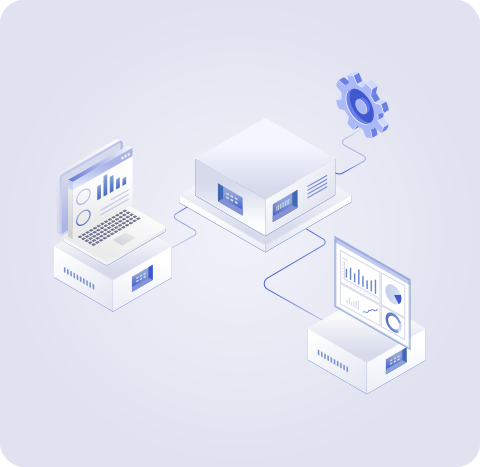
Orchestrate
Give your agent a map of all its connected systems
A live knowledge graph shows where information lives, so your agent always finds the right context.
Focus your agent on the tools that matter
Intent-based tool suggestions cut through the noise of large toolsets.
Prevent errors before they happen and recover when they do
Provide usage guidance before tool execution and contextual recovery when errors occur.
Learn domain-specific expertise on the fly
Custom Skill files teach your agent domain-specific procedures and workflows.
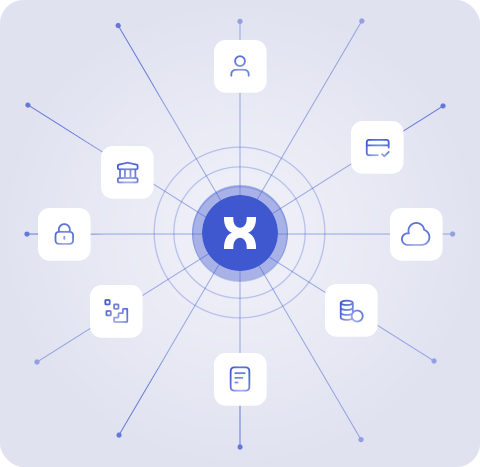
Govern
Handle every authentication method
OAuth, API keys, cookies, query params — managed at the team or per-user level with no custom code.
Enforce risk-aware tool permissions
Scope what each agent can do by user access level and the risk profile of each action.
Monitor every action with full visibility
Drill into tool traces to see which agents are doing what, on whose behalf, and where risks or errors emerge.
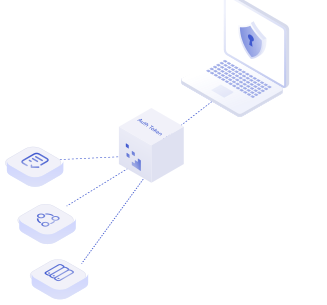
Caylex Learns From Every Action
Your agent's connected systems form an information network that gets smarter as your agents work.
With every action, Caylex discovers and refines context — making your agents more reliable, safe, and efficient.
Two ways to build on Caylex
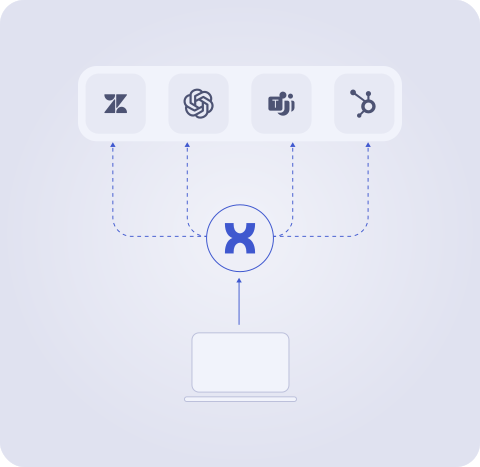
Embed a Caylex agent into your software platform, or plug your own agents into our infrastructure.
Replace complex point-and-click workflows with conversation
A more intuitive, powerful UX lets users automate end-to-end flows by chatting instead of clicking through modules.
Take action across your platform and every connected system
The agent connects natively to your platform's underlying API and orchestrates across external integrations through the Navigator.
Show, don't just tell
The agent can control your frontend to navigate pages and visually present completed work.
Embed in minutes, not months
Drop in one React component to get an agent chat widget, fully configured with your MCPs, permissions, and branding.
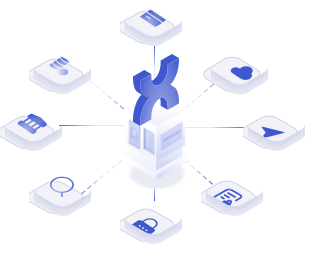
One connection to every system
Plug your agent into the Navigator and reach every connected system — swap or update MCPs anytime without re-configuring agent code.
Reliable, efficient, safe agent actions
The Navigator helps your agent work across all connected systems more reliably, efficiently, and safely.
Stay token-efficient at scale
Your agent uses the Navigator's simple toolset to reach every MCP — staying token-efficient even at hundreds of connected systems.
Visibility across every agent in your org
Track which agents access what, audit every action, and scan connected servers for security vulnerabilities.
Why teams build on Caylex
Reach the context that matters
Seamlessly unlock valuable context for your agents in industry-specific platforms and internal systems.
Make your platform agentic in days
Embed a Caylex agent into your platform — fluent in your data and ready to act across every connected system.
Reliable across every system
Reliability gets harder as agents touch more live systems. Caylex keeps tool selection sharp, errors recoverable, and context current — even at hundreds of connected systems.
Govern every agent, every action
See every action, enforce permissions per agent and user, and audit every execution — across agents built in-house, embedded, or third-party.
Information Networks for AI Agents